
The Red Elephants
Tsavo's elephants dust themselves with the park's red soil, giving them a striking colour that makes them instantly recognisable.

Climbing Kilimanjaro
The complete guideRoutes & fitness calculatorWhat to packOur climbs
6-Day Kilimanjaro: Marangu Route7-Day Kilimanjaro: Machame Route6-Day Kilimanjaro: Umbwe Route7-Day Kilimanjaro: Rongai Route7-Day Kilimanjaro: Shira Plateau / Morrum Barrier Route9-Day Kilimanjaro: Lemosho Route4-Day Mount Meru Trek5-Day Ol Doinyo Lengai & Lake Natron Trek10-Day Kilimanjaro Trekking & Wildlife Safari11-Day Kilimanjaro Trekking & Wildlife SafariTour styles
Big 5 Safaris (7)Great Migration Safaris (6)Classic Wildlife Safaris (32)Wildlife-Themed Safaris (8)Fly-in & Luxury Safaris (8)Honeymoon Safaris (6)Mountain Trekking (10)Beach & Zanzibar Holidays (9)Gorilla & Primate Safaris (19)Multi-Country & Combination Safaris (9)Helicopter Safaris (5)Cultural Tours (2)Day Trips (10)Family SafarisCity Tours & Airport TransfersTailor-Made / Custom TripsPlan
All toursTanzania safari guidePlan a custom tripTanzania
All of TanzaniaNational ParksGame ReservesIslandsHistorical SitesMountains & VolcanoesLakes & WaterfallsCities & CoastKenya
All of KenyaNational ParksReserves & ConservanciesMountains & CoastCitiesUganda
All of UgandaNational ParksWildlife ReservesLakes & WaterfallsCities & GatewaysMore
Cultural experiencesLodges & campsAll destinationsKenya National Parks
Endless plains of red earth, dust-coated elephants and the Galana River winding towards the Indian Ocean: Tsavo East is raw, vast and wonderfully wild.
Discover Tsavo East
Tsavo East National Park is one of the largest national parks in Kenya, spanning more than 13,000 km². As huge as it is impressive, it is also one of the country's oldest national parks, established in 1948. Its sweeping plains, open skies and sense of space are unlike anywhere else in Kenya.
Marvel at the park's vibrant wildlife and its dramatic geology. The Yatta Plateau, one of the longest lava flows in the world, runs along the park's western edge above wide, shallow valleys formed by ancient volcanic activity. The Galana River, the chief source of water for the animals of the park, flows through Tsavo East and on towards the Indian Ocean, and along its banks you may spot gargantuan crocodiles as you explore.
With excellent birdlife, the Tsavo River, Mudanda Rock, Kanderi Swamp, Aruba Dam and the Lugard Falls among its highlights, Tsavo East is a superb choice for travellers who want a true wilderness safari, and it is easily combined with the Kenyan coast.
Why Tsavo East
Tsavo East offers a sense of scale and solitude that few parks can match, with easy access from both Nairobi and Mombasa.
Tsavo's elephants dust themselves with the park's red soil, giving them a striking colour that makes them instantly recognisable.
The park's lifeline, lined with doum palms and home to crocodiles and hippos, with wildlife gathering along its banks in the dry season.
One of the longest lava flows in the world, forming a long ridge along the park's western edge.
See the Galana River surge through rocky channels at Lugard Falls, and watch elephants drink below the great rock outcrop of Mudanda.
The park is so large that you can often enjoy sightings with no other vehicles in sight.
Tsavo East is one of the easiest parks to combine with a beach stay at Mombasa, Diani or Watamu.
Location
Tsavo East lies in southeastern Kenya, east of the Nairobi–Mombasa highway and railway, opposite Tsavo West. The popular Voi gate is about 330 km from Nairobi (roughly 5 hours by road) and about 160 km from Mombasa (around 2.5 to 3 hours). The Standard Gauge Railway also stops at Voi and Mtito Andei, a comfortable way to arrive from either city.
From Arusha, most travellers enter Kenya at the Namanga border and travel via Amboseli and Tsavo West, or cross at Holili–Taveta near Moshi and head east to Voi, a journey of around 5 to 6 hours. Several airstrips inside and near the park serve charter flights.
When to visit
Tsavo East is hot and dry for much of the year. The dry seasons bring wildlife to the rivers and waterholes, while the rains transform the plains.
Prime game viewing, with elephants, buffalo and plains game concentrating along the Galana River and around Aruba Dam and Kanderi Swamp.
Brief showers bring fresh grass and flowering bush, and migratory birds arrive in good numbers.
Hot, mostly dry days with good wildlife viewing and green surroundings after the short rains.
The wettest period, with lush vegetation, scattered wildlife and some roads becoming difficult.
Visit in the dry months for concentrated wildlife, or in the green season for birding, quiet roads and dramatic skies.
Warm and fairly dry, with green plains and good game viewing.
Hot and dry, an excellent month for elephants near the rivers and dams.
The long rains begin, freshening the bush and dispersing wildlife.
Usually the wettest month, with lush scenery and very few visitors.
Rains ease and the park looks its greenest, with good birding.
The dry season returns and animals start to gather near permanent water.
Excellent game viewing along the Galana River and at Aruba Dam.
Prime season, with red elephants gathering at waterholes and rivers.
Dry and rewarding, ideal for Lugard Falls and Mudanda Rock.
Hot and dry, with dramatic concentrations of wildlife before the rains.
Short rains bring fresh growth and migratory birds.
Green and quiet, with good birding and pleasant game drives.
Explore the area
Most game viewing takes place south of the Galana River, where rivers, swamps and rock outcrops draw wildlife across the plains.
Wildlife
Tsavo East supports vibrant wildlife across its immense plains. Its red-dusted elephants are the most famous residents, alongside buffalo, lions, leopards and cheetahs. Plains game such as zebras, giraffes, impalas, hartebeest and gazelles share the park with dry-country specialists like the gerenuk, lesser kudu and fringe-eared oryx.
The Galana River and its swamps and dams are home to hippos and large Nile crocodiles, and birdlife is excellent, with hornbills, weavers, starlings, raptors and many migrants. The park's size means wildlife can be spread out, so experienced guides make all the difference.
Where to look: Rivers, dams and waterholes
Tsavo's famous red elephants, coloured by dust bathing in the red soil.
Where to look: Kanderi Swamp and the plains
Tsavo lions are often maneless or sparsely maned, like their legendary ancestors.
Where to look: Near water across the south
Large herds gather near swamps and rivers in the dry season.
Where to look: Riverine woodland and rocky areas
Present along the rivers and rock outcrops but elusive.
Where to look: Open plains
Tsavo East's open country gives a fair chance of cheetah sightings.
Where to look: Galana River and Crocodile Point
Gargantuan crocodiles bask on the riverbanks and sandbanks.
Where to look: Galana River and Aruba Dam
Pods rest in the deeper pools of the river and in the dam.
Where to look: Dry bush
A long-necked antelope that browses standing on its hind legs.
Where to look: Thickets and dense bush
A shy antelope with elegant white stripes.
Where to look: Open dry plains
A striking dry-country antelope with long, straight horns.
Where to look: Acacia bush
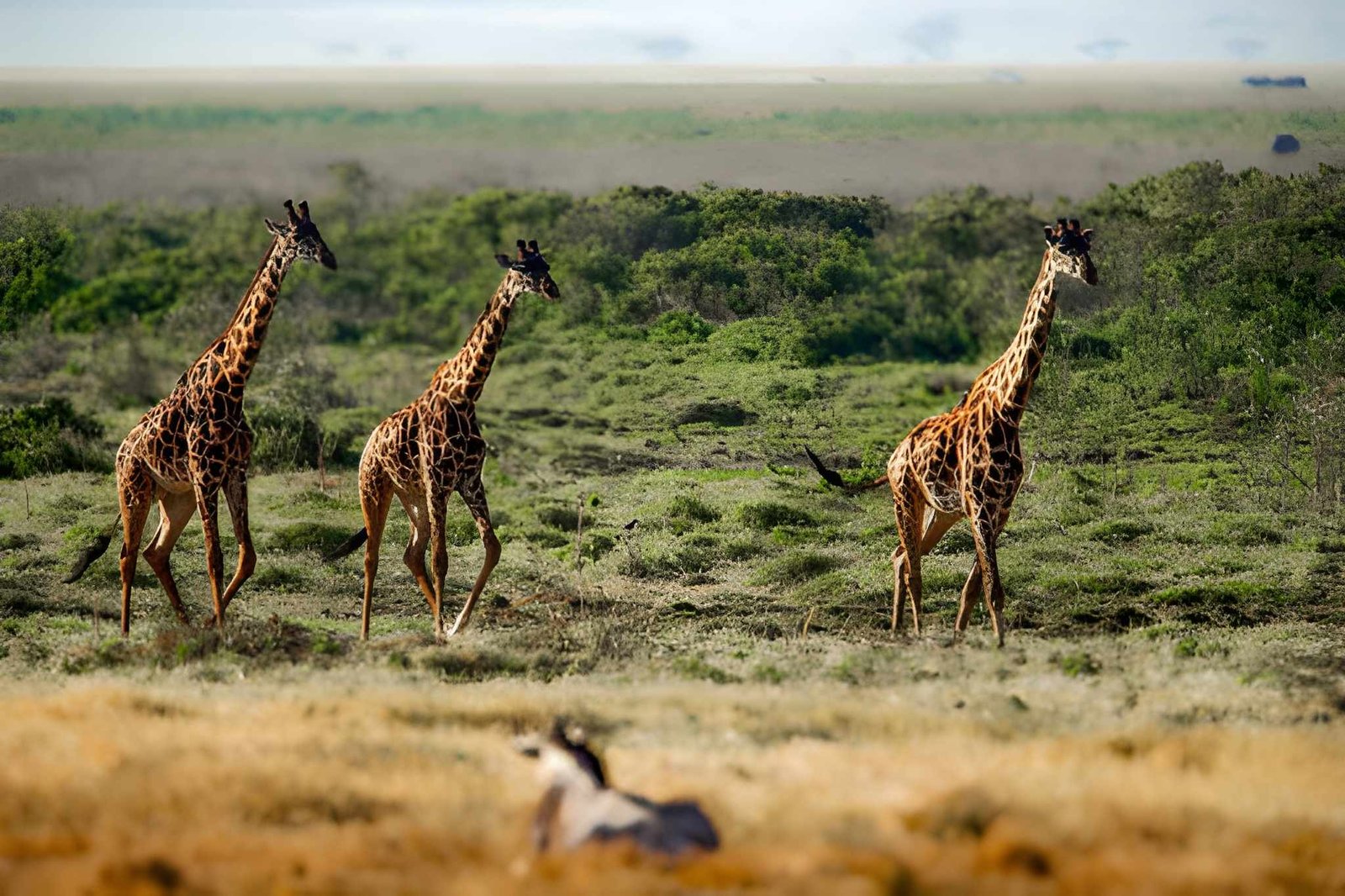
Masai giraffes, and in the north the reticulated variety, browse the acacias.
Where to look: Woodland and lodges
Red-billed and yellow-billed hornbills are easily seen across the park.

The Red Elephants of Tsavo
Tsavo East is home to one of Kenya's largest elephant populations, and these elephants are unlike any others. By spraying themselves with the park's fine red dust and wallowing in its mud, they take on a vivid rusty colour that glows in the low light of morning and evening.
In the dry season, herds converge on the Galana River, Aruba Dam, Kanderi Swamp and the water catchment beneath Mudanda Rock, offering memorable sightings in a landscape where you may be the only vehicle for miles.
Safaris to 中文
Itineraries that include Tsavo East, often combined with Tsavo West, Amboseli and a beach stay on the Kenyan coast.
Kenya · 11 days
Amboseli · Tsavo West · Tsavo East
Kenya · 15 days
Samburu National Reserve · Ol Pejeta Conservancy · Lake Nakuru · Lake Naivasha
Tanzania & Kenya · 13 days
Tarangire · Ngorongoro · Serengeti · Amboseli

Tell us how long you have and what you would love to see. A GIP Adventure specialist will help you plan a Tsavo East safari, combined with Tsavo West, Amboseli, the coast or northern Tanzania.
Usually replies within minutesHeritage
The Tsavo region has a long history as a crossing point between the coast and the interior, travelled by traders, explorers and, from the late nineteenth century, the builders of the Uganda Railway. Lugard Falls takes its name from Frederick Lugard, a colonial administrator who passed through the area. The legendary Tsavo man-eaters of 1898 made the region famous worldwide.
Tsavo was gazetted in 1948 and divided into East and West. In the 1970s and 1980s, poaching devastated its elephant and rhino populations, and the park became central to Kenya's fight against the ivory trade. Elephant numbers have since recovered substantially, and today rangers, researchers and neighbouring communities work to protect this vast ecosystem and its wildlife corridors.
They spray themselves with the park's fine red dust and wallow in red mud, which colours their skin.
More than 13,000 km², making it one of the largest national parks in Kenya.
The Voi gate is about 160 km from Mombasa, around 2.5 to 3 hours by road, which makes it a popular safari from the coast.
About 330 km to Voi, roughly 5 hours by road, or a comfortable journey on the Standard Gauge Railway.
Most visitors explore south of the Galana River, around Kanderi Swamp, Aruba Dam, Mudanda Rock and Lugard Falls.
Yes. Tsavo East pairs perfectly with a stay at Diani, Mombasa or Watamu on the Indian Ocean coast.
Wildlife viewing drives, bird watching, nature walks and hiking at selected sites with an experienced guide.
Your safari starts here
Let GIP Adventure plan a journey into Tsavo East's wild red-earth country, from the Galana River to the coast.
Chat with usOnline